
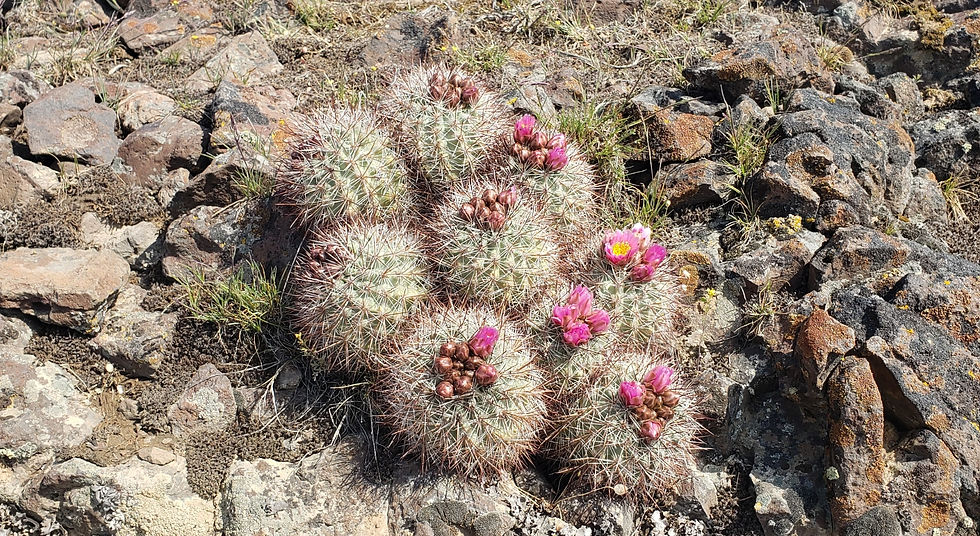
Pediocactus


Culture
Genrepediocactusis known for its resistance to cold but above all for its difficulty in cultivation. For my part, I think this is due to its particular growth rate. If you follow a few rules specific to this genus, their cultivation goes well and you will even be rewarded with flowering. Their growth period starts earlier than other genus of cacti andpediocactusrest during the hot summer period. They are therefore similar toaustrocactus. They appreciate early watering and good ventilation. If possible, do not leave them in a confined environment such as a greenhouse or provide enough ventilation. For my part, I cultivate them under a simple protection against the rain where the air can circulate freely. I also have a frame with openings on the side in the windiest part of the garden. I present to you below the species that I have in culture at home and the specific information that I have noted for each species.
Pediocactus simpsonii
-
Water in late February/early March until May even if it still freezes for the main growing season
-
Stop watering when night temperatures do not drop below 10-12°C (generally corresponds to the summer period)
-
Provide enough water in the fall for the production of flower buds
-
Water in autumn for the secondary growth period from September to November
To go further: Journal of the BCSS Cactus World vol 39 no 3, September 2021
Pediocactus knowltonii
-
Watering at the end of February/beginning of March even if it is still freezing
-
No water in summer (late June to late August). Plants go dormant.
-
Water at the end of summer when the days are getting cooler and stop watering in October
Pediocactus peeblesianus
-
Watering at the beginning of March even if it is still freezing
-
No water in summer (late June to late August). The plants go to rest.
-
Water at the end of summer when the days are getting cooler and stop watering in October
Pediocactus paradinei
-
Does not like water at the beginning of the year.
-
Prefers a shaded location.
-
Sensitive to rain and frost in winter.
-
Soil: 20% limestone, 3% humus.
Pediocactus winkleri
-
Water in late February/early March even if it is still freezing.
-
No water from early June to mid-August
-
Likes snow in winter and heat in summer
-
Highly draining limestone substrate
Pediocactus sileri
-
Water moderately once in December, once in January, once in February
-
Water heavily in spring until May and leave dry for the following 3 months (June to August)
-
Growing period only in spring
-
Water 1 to 2 times in September
-
Does not like heat at the roots, use light-colored pots (terracotta)
Pediocactus nigrispinus
-
Plenty of water in winter
-
Add acidity to the soil (pine needles, fir needles, thuja needles)
-
Substrate with volcanic rock and humus.
Pediocactus despainii
-
Likes snow in winter.
-
Very well-drained substrate.
Pediocactus bradyi
-
Water in late February/early March even if it is still freezing.
-
No water in summer.

Sowing
I sowedPediocactus peeblesianusin 2019. Despite their bad reputation, I had no problem germinating the seeds. Seeds were sown according to my baggy sowing method. It makes sense to plant the seeds 2-3 cm deep. To date, I have lost 2 out of 6 seedlings to rot. According to my research, this genus does not like repotting. For this reason and in view of their slow growth they are always in the pot.


Hardiness by species
Genus Pediocactus includes species that are very resistant to frost when the plant is kept dry. The following species withstood -12°C for -7 days at my house. Pediocactus simpsonnii is one of the most cold-hardy cacti. It is also known to resist winter humidity very well.
Support up to -25°:
-
Pediocactus simpsonnii
-
Pediocactus nigrispinus (syn. Pediocactus simpsonii var.nigrispinus)
Support -12°:
-
Pediocactus peeblesianus
-
Pediocactus knowltonii
-
Pediocactus paradinei
-
Pediocactus despainii
-
Pediocactus sileri
-
Pediocactus winkleri


